Today marks the one hundred anniversary of radio in Ireland, a lot has changed since then, but the medium is still holding it’s own a century on.
One hundred years ago there were an estimated 10,000 wireless sets in the country but no domestic stations on the air, this was all to change on January 1st 1926 when at 7.45pm Douglas Hyde launched 2RN from a studio above a small post office on Little Denmark Street in Dublin. The first public service broadcaster in the fledgling Irish Free State initially broadcast live for just three hours per night and could only be received within a 30km radius, meaning that the majority of license holders could still not receive the content that their license fees were helping to fund.
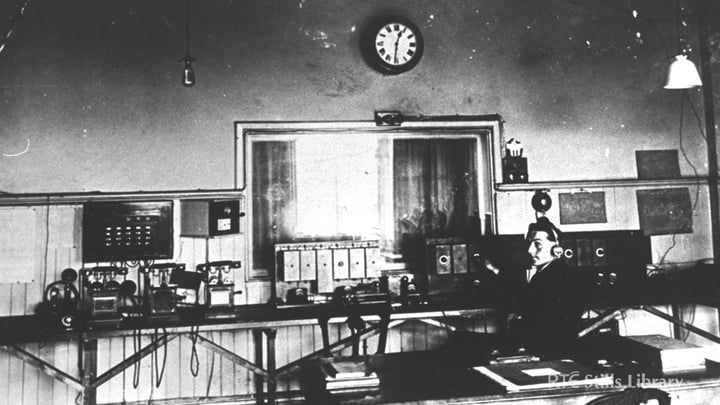
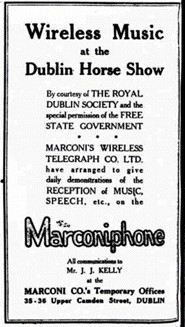
While this is generally considered as the birth of radio in Ireland the first public licensed broadcast had taken place a few years earlier when the Marconi Company received permission to broadcast as part of the RDS Horse Show. At 11am on the 14th August 1923 under the call-sign 2BP broadcasting began from Royal Marine Hotel, Dún Laoghaire, not only could it be heard on receivers set up in the exhibition area in Ballsbridge but by anyone with a receiver within 50 km, including by large crowds who gathered at stores that sold wireless sets. The broadcast continued until the 16th when the station was unexpectedly ‘Abandoned by Order’ of the Postmaster General.
Although they were not refereed to by the term Pirates at the time the presence amateur broadcasters on the dial soon became an issue, due to the ‘DIY’ nature of both their transmitters and their content. One example of this was the gentleman in Blackrock who was noted for his evening broadcasts which consisted of him giving a speech before playing some gramophone records via a transmitter that was powerful enough to reach France!
It was clear that the cat was out of the bag regarding radio and the government had to act, not only did it have a responsibility to control the limited frequency band but there was the larger concern that the presence of ‘foreign’ voices being beamed directly into Irish homes had the power to undermine the fledgling state. With the introduction of the Wireless Telegraphy Act, 1926 the government not only gave birth to public service broadcasting in Ireland but also established a state monopoly on the medium.
2RN was superseded by Radio Athlone (later renamed as Radio Éireann) when the state’s first high powered radio transmitter station was set up to cover the 1932 Eucharistic Congress. This established a national broadcasting presence and saw radio change from being a novelty to a key tool in state-crafting , connecting isolated rural communities and helping to establish a national identity.
In 1966, after launching a television service, Radio Éireann became Raidió Teilifís Éireann, or RTÉ by the 1970’s RTE Radio was seen as been increasingly out of touch with a changing Ireland with audiences increasing turning to the pirate stations that were prolific throughout the country. As an attempt to both become more relevant to they youth of the country and curb the rise of pirate radio RTÉ Radio 2 was launched in 1979 with a lineup that consisted mainly of former pirate radio DJs who were permitted to play ‘pop’ music that was up to that time missing from the national station.
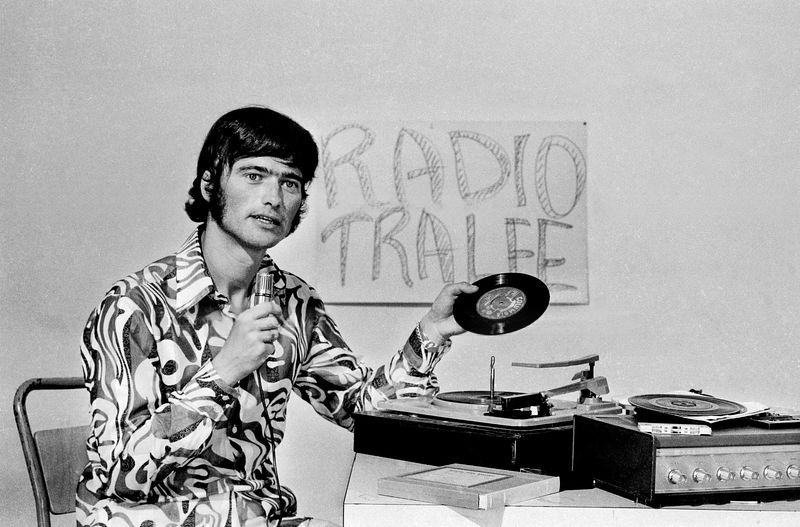
Pirate radio continued to thrive throughout the 70’s and 80’s until 1988 when the government closed the legal loophole that allow these to thrive and introduced commercial radio licenses, currently there are 33 commercial radio and 21 community stations in Ireland.
Today RTÉ broadcasts four broadcast national channels RTÉ Radio 1, RTÉ 2FM, Raidió na Gaeltachta, Lyric FM and one digital channel RTÉ Gold, ironically this is half of the number of channels it broadcast right up until yesterday (31st December 2025) when it ceased broadcasting it’s digital offerings RTÉ 2XM, RTÉ Chill, RTÉ Junior, RTÉ Pulse and RTÉ Radio 1 Extra.
These were launched in 2008 as part of RTÉ’s foray into Digital Audio Broadcasting (DAB), while they lost their broadcast status when RTÉ shut down it’s DAB services in 2021 these were kept running online and via digital TV platforms.
While RTÉ’s digital channels offered huge potential they never seem to have received the investment and promotion that would allow them to realise their potential. RTÉ 2XM and RTÉ Pulse provided a key platform for upcoming, underground and left-field Irish artists as well as aspiring DJ’s and producers, they hosted regular shows for niche genres that couldn’t be heard on either other RTÉ services or with the increasingly middle of the road commercial stations. The irony is that RTÉ 2FM itself is now seen to be totally out of touch with both the youth demographic and non-mainstream music fans offering nothing to differentiate it from the mainstream commercial stations.
While RTÉ has indicated that it will transition these services’ “niche content” to a refreshed 2FM schedule and into on-demand digital formats it has yet to be seem if any of the channel’s shows or presenters have a future with the broadcaster. There is a case to be made that RTÉ’s public service mandate would have been better served by selling 2FM off as a commercial service and investing the revenue in a proper alternative music station along the lines of BBC Radio 6 Music by combining aspects of 2XM and Pulse, this time it wouldn’t even have to poach DJ’s to become relevant, it had a whole roster of shows and DJs established already.
In 2016 RTÉ’s announcement of their intentions to outsource the production of all of its young person’s TV shows to the independent sector caused outrage across the board, on the other hand the shuttering of RTÉ Junior Radio barely got a mention. Although these are obviously on different scales in terms of audience I would imagine the budget required to keep RTÉ Junior Radio afloat would have been tiny, and thus the savings by closing it down insignificant. While the argument that the move to more on-demand digital formats might have some merit in the context of 2XM and Pulse this is not true of RTÉ Junior Radio, parents want to put on some quality content to entertain/educate their children they do not want to have to choose what to play once a particular show finishes, this is what radio excels at. In addition the content on this channel was extremely evergreen given the audience and once the content was developed it was ideal for replays given that the audience would quickly outgrown the service. Even just by commissioning a new show or two per year (which presumably RTÉ may still do as on-demand podcast content) this station could have been kept running on a shoestring.
Why I think this matters most is that in a time when we as a society are becoming increasingly aware of the emotional and behavioral problems in children due to screen use this was the only non-screen based media service available to Irish parents. This was an unsung offering and something that hits to the core of why radio endures as a medium: Trust – given that this was from a public broadcaster you could be confident that the content is age appropriate and of a certain quality; Passive Engagement – meaning that children could do other things such as draw or play with toys while listening; Accessibility this was a service that was free to all and could be accessed in a number of ways, on-line, broadcast (well DAB while it lasted) mobile app and via Saorview TV.
North of the border BBC Radio Ulster shelved it’s long‑running new music programme Across the Line last May, a show which had been championing new music from Northern Ireland for almost 40 years and provided the initial platform for a number of acts that went on to become household names. While this decision drew criticism from many across the north that were worried that locally‑focused music opportunities were being sidelined, it was part of a larger cul by BBC which axed specialist music shows on its local radio stations across the UK. In late 2025 BBC Radio Scotland face similar backlash following it’s decision to axe four longstanding curator-led music programmes by the end of the year, replacing them with a new late-night show featuring more mainstream, easy listening tracks with a more “mainstream appeal”. Overall the UK and Ireland enters a enters 2026 with a very different landscape in terms of specialist radio programming than existed just 12 months ago.
While BBC push for more mainstream content RTÉ cite ‘financial and efficiency factors’ for the closures of their digital stations claiming that there was ‘minimal audience demand for digital radio services’, both moves are seemingly oblivious to the global trend of community based digital radio that is spawning a second golden age of radio. While diverse in their content and programming what defines these stations is their emphasis on curated unique programming and providing a platform for diverse sounds and voices outside the mainstream, fostering communities of interest as well as communities of place.
Eschewing the costs associated with broadcast radio these online only stations can often avoid the commercial side of radio instead focusing on the content, what could be considered as radio in it’s purest form, even if it’s technically not radio ( unless you are listening to it over wifi but that’s a discussion for another day !).
There is another Irish radio anniversary this year with Dublin’s ddr. celebrating it’s tenth birthday, while only in operation for just a decade, it firmly placed itself in the Irish radio landscape, following in it’s footsteps last year saw the establishment of éist in Cork, both of these receive no funding through the license fee nor from advertisers with listeners and DJ’s instead funding and running the stations.
While it’s easy to view stations like ddr. and éist as merely filling the gap for non-mainstream musical genres in a landscape where both state and commercial broadcasters are increasing failing to do so but this would be to overlook their more radical aims, although on the surface these stations are considered non-commercial in that unlike mainstream radio stations they don’t play adverts a quick read of their /about pages reveals that this runs much deeper.
ddr.‘s Guiding Principles describes a member owned non-profit that “wants to build an open, inclusive and diverse community where differing points of view and opinions are respected.” one that ” … believes in an open and free internet & rejects the logic of surveillance capitalism.” while you will discover that éist is a volunteer-run internet radio collective with a commitment to anti-colonialism this is not just symbolic but … informs the content we platform, the spaces we nurture, and the relationships we engage in. As a collective rooted in global solidarity, we are guided by the principles of movements like the BDS campaign, which urges refusal with collaborations that normalize systemic oppression or presents false symmetry between oppressor and oppressed.
So after a hundred years the medium that began a highly innovative with the power to not only connect but also define a nation is still going strong, while the sounds of mainstream stations that fill our airwaves and becoming more and more sanatised and homogeneous it positive to be the mantle being taken up by independent online stations that focuses on social justice, artistic freedom and tunes that you are unlikely to hear elsewhere.
If radio is your thing you might be interested in an application I have been working on, it’s called schedulear and it’s changed the way I listen to radio.
It’s currently in private beta, you can join the waitlist here -> schedulear.com