Last week I spoke at the Cycling & Society Research Group Annual Symposium which was hosted by the Centre for Transport Research, Trinity College Dublin, with the overall theme ‘Critical Tensions in Planning for Cycling‘.
My presentation which was part of the Solidarities Session was entitled Cycle Space Invaders – Gamification of social media as a tool to protect cycle infrastructure, and was based on my Cycle Space Invaders project and the #FreeTheCycleLanes campaign.
The last decade has seen the humble Hashtag become a key tool in the arsenal of social and political activists throughout the world. Movements which consolidated organically across online social media (OSM) platforms around hashtags such as #OccupyWallStreet, #ArabSpring, BlackLivesMatter and #MeToo have manifested huge changes in the real world. In 2015 cyclists throughout Ireland took to OSM using FreeTheCycleLanes to highlight the issue of parking in cycle-lanes. While Hashtag Activism has been criticised for encouraging armchair activism, unlike other campaigns #FreeTheCycleLanes was mainly used to document infractions while also highlighting the issue and encouraging followers to do likewise. One of the drivers of Hashtag Activism campaigns is that the hashtag trends or goes viral. Due to the nature of the #FreeTheCycleLanes campaign and the size of the interest group this was never going to happen, also due to the temporal nature of OSM and the speed at which the timeline is updated older posts are no longer visible unless specifically searched for. These issues inspired the creation of CycleSpaceInvaders.com a website powered by #FreeTheCycleLanes Tweets, which makes use of gamification techniques to encourage users to document obstructions to cycle-lanes. Points are awarded for each post and a leaderboard was created, a gamification tactic which aims to encourage users to compete which in turn generates more activity. The site not only gives visibility to historic posts but it also serves to break them out of Twitter making them accessible and highlighting these issues outside of the walled garden.
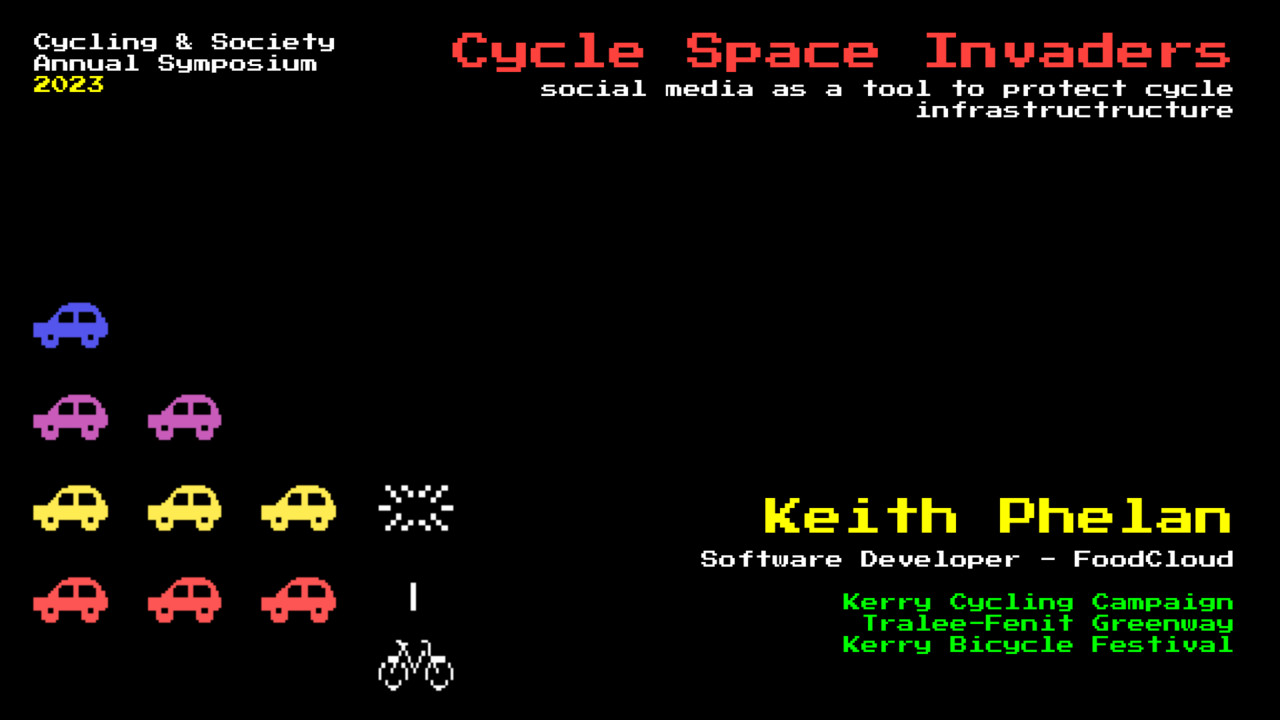
You can access my presentation here.